Saturday, July 25, 2020

5ZH Question Words Erph


.
seaha12
Hari Ahad
SLOT 1/2

Class : 5ZH
Date : 26-7-2020
Time : 8.00am-9.00am    
Remarks :    Question Words

Theme/ Topic : World of knowledge, / ?

Skills :  
[ ] Listening and Speaking
[ ] Reading  
[ ] Writing  
[/ ] Grammar  
[ ] Language Arts  


Contents / Learning stds :  
Listening Learning Standards
[ ] 1.1.1 Recognise and reproduce with support a range of target language phonemes
[ ] 1.1.4 Can talk about related topics with a limited words. 
[ ] 1.2.1  Understand with support the main idea of short simple texts
[ ] 1.2.2 Understand with support specific information and details of short simple texts
[ ] 1.2.3 Understand with support short simple narratives
[ ] 1.2.4 Understand a wide range of short basic supported classroom instructions
[ /] 1.2.5 Understand a wide range of short supported questions
[ ] 1.3.1 Guess the meaning of unfamiliar words by using visual clues when a teacher or classmate is speaking

Speaking Learning Standards
[ ] 2.1.1 Ask about and express basic opinions
[ ] 2.1.2 Find out about and describe basic everyday routines
[ ] 2.1.3 Give a short sequence of basic directions
[ ] 2.1.4 Ask about, make and respond to simple predictions
[ ] 2.1.5 Describe people and objects using suitable words and phrases
[ ] 2.2.1 Keep interaction going in short exchanges by repeating key words from the other speaker
[ ] 2.2.2 Ask for attention or help from a teacher or classmate by using suitable questions
[ ] 2.3.1 Narrate very short basic stories and events  
Reading Learning Standards
[ ] 3.2.1 Understand the main idea of short simple texts
[ ] 3.2.2 Understand specific information and details of short simple texts
[ ] 3.2.4 Recognise and use with support key features of a simple monolingual dictionary
[ ] 3.3.1 Read and enjoy Al fiction/non-fiction print and digital texts of interest
[ ] 3.2.3 Guess the meaning of unfamiliar words from clues provided by visuals and the topic


Writing Learning standards
[ ] 4.1.2 Begin to use cursive handwriting in a limited range of written work
[ ] 4.2.1 Express simple opinions
[ ] 4.2.2 Make and give reasons for simple predictions
[ ] 4.2.3 Give simple directions
[ ] 4.1.4 Describe people and objects using suitable words and phrases
[ ] 4.2.5 Connect sentences using basic coordinating conjunctions Use capital letters, full stops and question marks appropriately in guided writing at
[ ] 4.3.1 sentence level
[ ] 4.3.2 Spell an increased range of familiar high frequency words accurately in guided writing
[ ] 4.3.3 Plan, draft and write an increased range of simple sentences

Language Arts Learning Standards
[ ] 5.1.1 Enjoy and appreciate rhymes, poems and songs
[ ] 5.1.2 Say the words in simple texts, and sing simple songs with intelligible pronunciation, rhythm and intonation:
(1) simple chants and raps (ii) simple rhymes (iii) simple action songs (iv) simple songs (v) simple poems
[ ] 5.2.1 Ask and answer simple questions about characters, actions text and events of interest in a text.
[ ] 5.3.1 Respond imaginatively and intelligibly through creating simple action songs on familiar topics. Other imaginative responses as appropriate.

Objective : At the end of the lesson, pupils are able to complete written exercise on question words

Teaching and Learning Strategies :
[ ] 1. Visualization
[ ] 2. Cooperative learning
[ ] 3. Inquiry-based instruction
[ ] 4. Differentiation
[ ] 5. Technology in the classroom
[ ] 6. Behaviour management
[ ] 7. Professional development       
[ ] 8. Project based
[/ ] 9. Nil

LEARNING STRATEGIES :        
[ ] 1. SQ3R, Survey, Questions,Read,Recall,Review
[ ] 2. double loop learning (  Argyris )
[ ] 3. conversation theory (   Pask)
[ ] 4. lateral thinking ( DeBono   )
[ ] 5. social interaction, Situated Learning Theory Weinstein (1991)
[ ] 6. Story Telling & Reading.
[ /] 7. Nil

Teaching and Learning Activities :  
1. Sample sentences on question words
2. Rearrange words to form questions.
3. Answer simple questions.

Materials / References :  
[ ] Textbook
[ ] Workbook
[ ] Internet Search Engine
[ ] Apps / Installed Programmes
[ ] Inquiry, Interview
[ ] Audio CD with player. 
[ ]  Blank A4  papers, about  100  pcs.
[ ] Worksheets
[/ ] Personal organisation

PAK21 elements : -  
[ ] Teamwork
[ ] Reasoning
[ ] Proficiency in using technologies
[ ] 3Rs and 4Cs Strong academic skills
[ ] Thinking
[ ] Edutainment
[ ] Search engine and sharing of ideas, data 
[ ] language games
[ ] Story telling
[ ] craftwork
[/] Nil


• Success Criteria : Pupils complete tasks, verbally & written.

Pre-lesson :         
WH question words-Intro.

Lesson development :  
1. Intro
2. Forming sentences
.
Post-lesson :
Checking other's possible answers.

EMK (Elemen Merentas Kurikulum) :         
-

MORAL VALUES :  
[ ] 1. KINDHEARTEDNESS
[ ] 2. SELF-RELIANCE
[ ] 3. HUMANITY
[ ] 4. MUTUAL RESPECT
[ ] 5. LOVE
[ ] 6. JUSTICE
[ ] 7. FREEDOM
[ ] 8. COURAGE
[ ] 9. CLEANLINESS OF BODY AND MIND
[ ] 10. HONESTY/INTEGRITY
[/ ] 11. DILIGENCE
[ ] 12. COOPERATION
[ ]1 3. MODERATION
[ ] 14. GRATITUDE
[ ] 15. RATIONALITY
[ ] 16. PUBLIC SPIRITEDNESS
[ ] 17. Adaptation
[ ] 18. Time management

I-THINK MAP :  

[ ] 1. circle map
[ ] 2.bubble map
[ ] 3.double bubble map
[ ] 4. tree map
[ ] 5. Brace map
[ ] 6. Multiflow map
[ ] 7. Brace map
[ ] 8. Bridge map
[ /] 9. Nil

THINKING SKILLS
[ ] 1. Make a connection
[ ] 2. Compares and differs
[ ] 3. To clarify
[/ ] 4. organize
[ ] 5. Identify true and wrong statements
[ ] 6. Identify statement based on facts and opinions.
[ ] 7. Identify bias statements
[ ] 8. Identify causes and expressing various causes.
[ ] 9. Identify the consequenses and forecast various consequences.
[ ] 10. Make inferences and initial conclusions
[ ] 11. Make generalization and hypotheses.
[ ] 12.Interpreting
[ ] 13. Identify key ideas, support ideas and detailed details.
[ ] 14. Formulate and summarize
[ ] 15. Making decisions.
[ ] 16. Trouble shooting.
[ ] Others : Repetition is the key fluency.


MULTIPLE INTELLIGENCE :  
[ /] 1.Linguistic intelligence (“word smart”)  
[ ] 2.Spatial intelligence (“picture smart”)  
[ ] 3. Musical intelligence (“music smart”)  
[ ] 4. Bodily-Kinesthetics intelligence (“body smart”)  
[ ] 5. Naturalist intelligence (“nature smart”)  
[ ] 6. Logical-mathematical intelligence (“number/reasoning smart”)  
[ ] 7. Interpersonal intelligence (“people smart”)  


Assessment :         
1. Written works / Worksheets:  
- Grammar drills, written.
2. Teacher's Observations :      Kids complete their written tasks
3. Practical Works :  
Ask & answer, practise speaking sessions
4. Questions / Quizzes :
Some Wh questions asked verbally, to stir-up, to motivate thinking, to think hard.
Reflections/Impact :  
...Iearning is useful, for enhancing learning capabilities.


Remedial / Enrichment :  
Guidance  is  given  to  the  below  average  group,  by   teacher's  help, personally
****************************************************        


Wednesday, July 22, 2020

3TB Action Words Vocab


sekha22
Hari Khamis
SLOT 2/2

Class : 3 AS-SYATIBI    
Date : 23-7-2020
Time : 10.30am-11.30am    
Remarks :    Action Words


Theme/ Topic : World of knowledge, / Action Words, Vocab.drills

Skills :  
[/ ] Listening
[ ] Speaking
[ ] Reading  
[ /] Writing  
[ ] Grammar  
[ ] Language Arts  


Contents / Learning stds :  
Listening Learning Standards
[ ] 1.1.1 Recognise and reproduce with support a range of target language phonemes
[ ] 1.1.4 Can talk about related topics with a limited words. 
[ ] 1.2.1  Understand with support the main idea of short simple texts
[ ] 1.2.2 Understand with support specific information and details of short simple texts
[/ ] 1.2.3 Understand with support short simple narratives
[ ] 1.2.4 Understand a wide range of short basic supported classroom instructions
[ ] 1.2.5 Understand a wide range of short supported questions
[ ] 1.3.1 Guess the meaning of unfamiliar words by using visual clues when a teacher or classmate is speaking

Speaking Learning Standards
[ ] 2.1.1 Ask about and express basic opinions
[ ] 2.1.2 Find out about and describe basic everyday routines
[ ] 2.1.3 Give a short sequence of basic directions
[ ] 2.1.4 Ask about, make and respond to simple predictions
[ ] 2.1.5 Describe people and objects using suitable words and phrases
[ ] 2.2.1 Keep interaction going in short exchanges by repeating key words from the other speaker
[ ] 2.2.2 Ask for attention or help from a teacher or classmate by using suitable questions
[ ] 2.3.1 Narrate very short basic stories and events  
Reading Learning Standards
[ ] 3.2.1 Understand the main idea of short simple texts
[ ] 3.2.2 Understand specific information and details of short simple texts
[ ] 3.2.4 Recognise and use with support key features of a simple monolingual dictionary
[ ] 3.3.1 Read and enjoy Al fiction/non-fiction print and digital texts of interest
[ ] 3.2.3 Guess the meaning of unfamiliar words from clues provided by visuals and the topic


Writing Learning standards
[ ] 4.1.2 Begin to use cursive handwriting in a limited range of written work
[ ] 4.2.1 Express simple opinions
[ ] 4.2.2 Make and give reasons for simple predictions
[ ] 4.2.3 Give simple directions
[ ] 4.1.4 Describe people and objects using suitable words and phrases
[ ] 4.2.5 Connect sentences using basic coordinating conjunctions Use capital letters, full stops and question marks appropriately in guided writing at
[ ] 4.3.1 sentence level
[/ ] 4.3.2 Spell an increased range of familiar high frequency words accurately in guided writing
[ ] 4.3.3 Plan, draft and write an increased range of simple sentences

Language Arts Learning Standards
[ ] 5.1.1 Enjoy and appreciate rhymes, poems and songs
[ ] 5.1.2 Say the words in simple texts, and sing simple songs with intelligible pronunciation, rhythm and intonation:
(1) simple chants and raps (ii) simple rhymes (iii) simple action songs (iv) simple songs (v) simple poems
[ ] 5.2.1 Ask and answer simple questions about characters, actions text and events of interest in a text.
[ ] 5.3.1 Respond imaginatively and intelligibly through creating simple action songs on familiar topics. Other imaginative responses as appropriate.

Objective : At the end of the lesson, pupils are able to listen & write action words

Teaching and Learning Strategies :
[ ] 1. Visualization
[ ] 2. Cooperative learning
[ ] 3. Inquiry-based instruction
[ ] 4. Differentiation
[ ] 5. Technology in the classroom
[ ] 6. Behaviour management
[ ] 7. Professional development       
[ ] 8. Project based
[ /] 9. Spelling

LEARNING STRATEGIES :        
[ ] 1. SQ3R, Survey, Questions,Read,Recall,Review
[ ] 2. double loop learning (  Argyris )
[ ] 3. conversation theory (   Pask)
[ ] 4. lateral thinking ( DeBono   )
[ ] 5. social interaction, Situated Learning Theory Weinstein (1991)
[ ] 6. Story Telling & Reading.
[/ ] 7. Nil

Teaching and Learning Activities :  
1. Study pictures
2. listen & write
3. Spelling (Writing words without listening)

Materials / References :  
[ ] Textbook
[ ] Workbook
[ ] Internet Search Engine
[ ] Apps / Installed Programmes
[ ] Inquiry, Interview
[ ] Audio CD with player. 
[ ]  Blank A4  papers, about  100  pcs.
[/ ] Worksheets
[ ] Personal organisation

PAK21 elements : -  
[ ] Teamwork
[ ] Reasoning
[ ] Proficiency in using technologies
[ ] 3Rs and 4Cs Strong academic skills
[ ] Thinking
[ ] Edutainment
[ ] Search engine and sharing of ideas, data 
[ ] language games
[ ] Story telling
[ ] craftwork
[/ ] Nil


• Success Criteria : Pupils show great interest to.complete the exercise.

Pre-lesson :         
Physically active, intro to action Words (verbs).

Lesson development :  
1. Listen & Write
2.  Corrections

Post-lesson :
More challenging task.
Dictation


EMK (Elemen Merentas Kurikulum) :         
Language & actions

MORAL VALUES :  
[ ] 1. KINDHEARTEDNESS
[ ] 2. SELF-RELIANCE
[ ] 3. HUMANITY
[ ] 4. MUTUAL RESPECT
[ ] 5. LOVE
[ ] 6. JUSTICE
[ ] 7. FREEDOM
[ ] 8. COURAGE
[ ] 9. CLEANLINESS OF BODY AND MIND
[ ] 10. HONESTY/INTEGRITY
[/ ] 11. DILIGENCE
[ ] 12. COOPERATION
[ ]1 3. MODERATION
[ ] 14. GRATITUDE
[ ] 15. RATIONALITY
[ ] 16. PUBLIC SPIRITEDNESS
[ ] 17. Adaptation
[ ] 18. Time management

I-THINK MAP :  

[ ] 1. circle map
[ ] 2.bubble map
[ ] 3.double bubble map
[ ] 4. tree map
[ ] 5. Brace map
[ ] 6. Multiflow map
[ ] 7. Brace map
[ ] 8. Bridge map
[/ ] 9. Nil

THINKING SKILLS
[ ] 1. Make a connection
[ ] 2. Compares and differs
[ ] 3. To clarify
[ ] 4. organize
[ ] 5. Identify true and wrong statements
[ ] 6. Identify statement based on facts and opinions.
[ ] 7. Identify bias statements
[ ] 8. Identify causes and expressing various causes.
[ ] 9. Identify the consequenses and forecast various consequences.
[ ] 10. Make inferences and initial conclusions
[ ] 11. Make generalization and hypotheses.
[ ] 12.Interpreting
[ ] 13. Identify key ideas, support ideas and detailed details.
[ ] 14. Formulate and summarize
[ ] 15. Making decisions.
[ ] 16. Trouble shooting.
[ ] Others : Repetition is the key fluency.
[/] Nil


MULTIPLE INTELLIGENCE :  
[/ ] 1.Linguistic intelligence (“word smart”)  
[ ] 2.Spatial intelligence (“picture smart”)  
[ ] 3. Musical intelligence (“music smart”)  
[ ] 4. Bodily-Kinesthetics intelligence (“body smart”)  
[ ] 5. Naturalist intelligence (“nature smart”)  
[ ] 6. Logical-mathematical intelligence (“number/reasoning smart”)  
[ ] 7. Interpersonal intelligence (“people smart”)  


Assessment :         
1. Written works / Worksheets:  
- Complete written task,
2. Teacher's Observations :      Kids able to finish the writing exercise.
3. Practical Works :  
-
4. Questions / Quizzes :
Some Wh questions asked verbally, to stir-up, to motivate thinking, to think hard.
Reflections/Impact :  
...Iearning is useful, for enhancing learning capabilities.
Blog :   
bit.ly/3tbactions
Remedial / Enrichment :  
Guidance  is  given  to  the  below  average  group,  by   teacher's  help, personally
****************************************************        


5Zh story time: King Sam


sekha12
Hari Khamis
SLOT 1/2

Class : 5ZH
Date : 23-7-2020
Time : 8.30am-9.30pm    
Remarks :    Reading a story Page 64, King Sam


Theme/ Topic : World of knowledge, / Story time

Skills :  
[ ] Listening and Speaking
[/ ] Reading  
[ ] Writing  
[ ] Grammar  
[ ] Language Arts  


Contents / Learning stds :  
Listening Learning Standards
[ ] 1.1.1 Recognise and reproduce with support a range of target language phonemes
[ ] 1.1.4 Can talk about related topics with a limited words. 
[ ] 1.2.1  Understand with support the main idea of short simple texts
[ ] 1.2.2 Understand with support specific information and details of short simple texts
[ ] 1.2.3 Understand with support short simple narratives
[ ] 1.2.4 Understand a wide range of short basic supported classroom instructions
[ ] 1.2.5 Understand a wide range of short supported questions
[ ] 1.3.1 Guess the meaning of unfamiliar words by using visual clues when a teacher or classmate is speaking

Speaking Learning Standards
[ ] 2.1.1 Ask about and express basic opinions
[ ] 2.1.2 Find out about and describe basic everyday routines
[ ] 2.1.3 Give a short sequence of basic directions
[ ] 2.1.4 Ask about, make and respond to simple predictions
[ ] 2.1.5 Describe people and objects using suitable words and phrases
[ ] 2.2.1 Keep interaction going in short exchanges by repeating key words from the other speaker
[ ] 2.2.2 Ask for attention or help from a teacher or classmate by using suitable questions
[ ] 2.3.1 Narrate very short basic stories and events  
Reading Learning Standards
[ ] 3.2.1 Understand the main idea of short simple texts
[ ] 3.2.2 Understand specific information and details of short simple texts
[ ] 3.2.4 Recognise and use with support key features of a simple monolingual dictionary
[/ ] 3.3.1 Read and enjoy Al fiction/non-fiction print and digital texts of interest
[ /] 3.2.3 Guess the meaning of unfamiliar words from clues provided by visuals and the topic


Writing Learning standards
[ ] 4.1.2 Begin to use cursive handwriting in a limited range of written work
[ ] 4.2.1 Express simple opinions
[ ] 4.2.2 Make and give reasons for simple predictions
[ ] 4.2.3 Give simple directions
[ ] 4.1.4 Describe people and objects using suitable words and phrases
[ ] 4.2.5 Connect sentences using basic coordinating conjunctions Use capital letters, full stops and question marks appropriately in guided writing at
[ ] 4.3.1 sentence level
[ ] 4.3.2 Spell an increased range of familiar high frequency words accurately in guided writing
[ ] 4.3.3 Plan, draft and write an increased range of simple sentences

Language Arts Learning Standards
[ ] 5.1.1 Enjoy and appreciate rhymes, poems and songs
[ ] 5.1.2 Say the words in simple texts, and sing simple songs with intelligible pronunciation, rhythm and intonation:
(1) simple chants and raps (ii) simple rhymes (iii) simple action songs (iv) simple songs (v) simple poems
[ ] 5.2.1 Ask and answer simple questions about characters, actions text and events of interest in a text.
[ ] 5.3.1 Respond imaginatively and intelligibly through creating simple action songs on familiar topics. Other imaginative responses as appropriate.

Objective : At the end of the lesson, pupils are able to read and predict outcomes

Teaching and Learning Strategies :
[ ] 1. Visualization
[ ] 2. Cooperative learning
[/ ] 3. Inquiry-based instruction
[ ] 4. Differentiation
[ ] 5. Technology in the classroom
[ ] 6. Behaviour management
[ ] 7. Professional development       
[ ] 8. Project based
[ ] 9. Nil

LEARNING STRATEGIES :        
[ ] 1. SQ3R, Survey, Questions,Read,Recall,Review
[ ] 2. double loop learning (  Argyris )
[ ] 3. conversation theory (   Pask)
[ ] 4. lateral thinking ( DeBono   )
[ ] 5. social interaction, Situated Learning Theory Weinstein (1991)
[ /] 6. Story Telling & Reading.
[ ] 7. Nil

Teaching and Learning Activities :  
1. Identify unfamiliar words
2. Read along
3. Predict outcomes

Materials / References :  
[ /] Textbook
[ ] Workbook
[ ] Internet Search Engine
[ ] Apps / Installed Programmes
[ ] Inquiry, Interview
[ ] Audio CD with player. 
[ ]  Blank A4  papers, about  100  pcs.
[ ] Worksheets
[ ] Personal organisation

PAK21 elements : -  
[ ] Teamwork
[ ] Reasoning
[ ] Proficiency in using technologies
[ ] 3Rs and 4Cs Strong academic skills
[ ] Thinking
[ ] Edutainment
[ ] Search engine and sharing of ideas, data 
[ ] language games
[/ ] Story telling
[ ] craftwork


• Success Criteria : Pupils keep asking for outcomes

Pre-lesson :         
Pre-reading, scanning

Lesson development :  
1. skimming
2.  Answer comprehension questions verbally.
.
Post-lesson :
moral values-discussion
EMK (Elemen Merentas Kurikulum) :         
History, Malacca Sultanate

MORAL VALUES :  
[ ] 1. KINDHEARTEDNESS
[ ] 2. SELF-RELIANCE
[ ] 3. HUMANITY
[ ] 4. MUTUAL RESPECT
[ ] 5. LOVE
[ ] 6. JUSTICE
[ ] 7. FREEDOM
[/ ] 8. COURAGE
[ ] 9. CLEANLINESS OF BODY AND MIND
[ ] 10. HONESTY/INTEGRITY
[ ] 11. DILIGENCE
[ ] 12. COOPERATION
[ ]1 3. MODERATION
[ ] 14. GRATITUDE
[ ] 15. RATIONALITY
[ ] 16. PUBLIC SPIRITEDNESS
[ ] 17. Adaptation
[ ] 18. Time management

I-THINK MAP :  

[ ] 1. circle map
[ ] 2.bubble map
[ ] 3.double bubble map
[ ] 4. tree map
[ ] 5. Brace map
[ ] 6. Multiflow map
[ ] 7. Brace map
[ ] 8. Bridge map
[/ ] 9. Nil

THINKING SKILLS
[ ] 1. Make a connection
[ ] 2. Compares and differs
[ ] 3. To clarify
[ ] 4. organize
[ ] 5. Identify true and wrong statements
[ ] 6. Identify statement based on facts and opinions.
[ ] 7. Identify bias statements
[ ] 8. Identify causes and expressing various causes.
[ ] 9. Identify the consequenses and forecast various consequences.
[ ] 10. Make inferences and initial conclusions
[ ] 11. Make generalization and hypotheses.
[ ] 12.Interpreting
[/ ] 13. Identify key ideas, support ideas and detailed details.
[ ] 14. Formulate and summarize
[ ] 15. Making decisions.
[ ] 16. Trouble shooting.
[ ] Others : Repetition is the key fluency.


MULTIPLE INTELLIGENCE :  
[ /] 1.Linguistic intelligence (“word smart”)  
[ ] 2.Spatial intelligence (“picture smart”)  
[ ] 3. Musical intelligence (“music smart”)  
[ ] 4. Bodily-Kinesthetics intelligence (“body smart”)  
[ ] 5. Naturalist intelligence (“nature smart”)  
[ ] 6. Logical-mathematical intelligence (“number/reasoning smart”)  
[ ] 7. Interpersonal intelligence (“people smart”)  


Assessment :         
1. Written works / Worksheets:  
Nil
2. Teacher's Observations :      Kids talked about the possible outcomes.
3. Practical Works :  
Read along and read aloud.
4. Questions / Quizzes :
Some Wh questions asked verbally, to stir-up, to motivate thinking, to think hard.
Reflections/Impact :  
...Iearning is useful, for enhancing learning capabilities.
Blog :   
bit.ly/5zhkingsam
Remedial / Enrichment :  
Guidance  is  given  to  the  below  average  group,  by   teacher's  help, personally
****************************************************        


Sunday, July 19, 2020

Answer for Visit to Negeri Sembilan


.


Abu is my friend. He is a smart and cheerful boy.He likes travelling and reading too.

Last week, Abu and his family went to Negeri Sembilan to visit Istana Seri Menanti. It was a wooden building and it was constructed without nails. It was a very unique palace.
Nowadays, the state museum of Negeri Sembilan displays all the exhibits and belongings of the royal family. A tour guide brought them around in the museum.
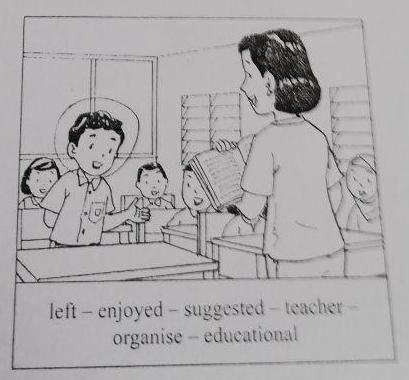
He left Negeri Sembilan and back to Kuala Lumpur. He enjoyed himself with the trip. Abu suggested to his teacher to organise an education trip to Negeri Sembilan during the school holiday.


user1924930 · Visit To Negeri Sembilan


family-Istana Seri Menanti- wooden-
constructed without- nails- palace

now- museum- exhibits- belongings
-royal- tour guide - around 


left - enjoyed -suggested - teacher -
organise - educational


Essay writing : A visit to Negeri Sembilan

.

Dear parents and all students,
There are 8 steps to be followed through in this lesson 
STEPS :
1.0 Watch video clip from Youtube, 
2.0 Study the pictures and getting to know the keywords.
3.0 Listen to the audio and read along with a passage of story.
4.0 Complete the sentences by filling in the blanks with words.
5.0 Complete the written exercises.
1.0  Watch the video clip below. Get to know about the state of Negeri Sembilan in Malaysia.


2.0 
Read the pictures below :

family-Istana Seri Menanti- wooden-
constructed without- nails- palace

now- museum- exhibits- belongings
-royal- tour guide - around 


left - enjoyed -suggested - teacher -
organise - educational


3.0 
Listen to the audio by clicking the link below, and read along .  
(Make sure you have switched on your audio speaker , Choose "Listen in Browser" if you are using mobile-phone)


4.0 
Complete the sentences below by listening to the audio again. Do not peep at the answers, try to listen carefully, listen attentively to the audio and complete the task.


Abu is my friend. He is a smart and cheerful boy.He likes travelling and reading too.
Last week, Abu and his _____________ went to Negeri Sembilan to visit _________________. It was a ______ building and it was _________without __________. It was a very unique _____________.

Nowadays, the state museum of Negeri Sembilan displays all the ________________ and _____________of the royal family. A tour guide brought them ____________ in the museum.


He left Negeri Sembilan and back to Kuala Lumpur. He enjoyed himself with the trip. Abu _____________ to his teacher to _______________an ____________trip to Negeri Sembilan during the school holiday.


5.0
Complete the above fill in the blanks exercise.
Do you know the answers? 
Please listen to the audio clip in step 3.0 , you can discuss with your family members, your parents , your siblings, or anyone, for the answers.
Still, if you are in doubt. you do not know the answers, you can click the hyperlink below for the complete answer. 


Please share this webpage, bit.ly/n9visit to anyone. Sharing is caring.


.


Do you like this homework? What do you think ? Remember to tell Mr. Goh down here in the comments section. Let's talk about anything down here. I miss you all.

Saturday, July 18, 2020

5ZH Essay , A Visit to Negeri Sembilan


Disca22
Hari Ahad SLOT 2/2
/a22
Class : 5ZH
Date : 19-7-2020
Time : 12.15pm-1.15pm    
Remarks :     
Essay writing
Theme/ Topic : World of knowledge, / Visit to Negeri Sembilan

Skills :  
[ ] Listening and Speaking
[ ] Reading  
[/ ] Writing  
[ ] Grammar  
[ ] Language Arts  


Contents / Learning stds :  
Listening Learning Standards
[ ] 1.1.1 Recognise and reproduce with support a range of target language phonemes
[ ] 1.1.4 Can talk about related topics with a limited words. 
[ ] 1.2.1  Understand with support the main idea of short simple texts
[ ] 1.2.2 Understand with support specific information and details of short simple texts
[ ] 1.2.3 Understand with support short simple narratives
[ ] 1.2.4 Understand a wide range of short basic supported classroom instructions
[ ] 1.2.5 Understand a wide range of short supported questions
[ ] 1.3.1 Guess the meaning of unfamiliar words by using visual clues when a teacher or classmate is speaking

Speaking Learning Standards
[ ] 2.1.1 Ask about and express basic opinions
[ ] 2.1.2 Find out about and describe basic everyday routines
[ ] 2.1.3 Give a short sequence of basic directions
[ ] 2.1.4 Ask about, make and respond to simple predictions
[ ] 2.1.5 Describe people and objects using suitable words and phrases
[ ] 2.2.1 Keep interaction going in short exchanges by repeating key words from the other speaker
[ ] 2.2.2 Ask for attention or help from a teacher or classmate by using suitable questions
[ ] 2.3.1 Narrate very short basic stories and events  
Reading Learning Standards
[ ] 3.2.1 Understand the main idea of short simple texts
[ ] 3.2.2 Understand specific information and details of short simple texts
[ ] 3.2.4 Recognise and use with support key features of a simple monolingual dictionary
[ ] 3.3.1 Read and enjoy Al fiction/non-fiction print and digital texts of interest
[ ] 3.2.3 Guess the meaning of unfamiliar words from clues provided by visuals and the topic


Writing Learning standards
[/ ] 4.1.2 Begin to use cursive handwriting in a limited range of written work
[ ] 4.2.1 Express simple opinions
[ ] 4.2.2 Make and give reasons for simple predictions
[ ] 4.2.3 Give simple directions
[ ] 4.1.4 Describe people and objects using suitable words and phrases
[ ] 4.2.5 Connect sentences using basic coordinating conjunctions Use capital letters, full stops and question marks appropriately in guided writing at
[/ ] 4.3.1 sentence level
[ ] 4.3.2 Spell an increased range of familiar high frequency words accurately in guided writing
[ ] 4.3.3 Plan, draft and write an increased range of simple sentences

Language Arts Learning Standards
[ ] 5.1.1 Enjoy and appreciate rhymes, poems and songs
[/ ] 5.1.2 Say the words in simple texts, and sing simple songs with intelligible pronunciation, rhythm and intonation:
(1) simple chants and raps (ii) simple rhymes (iii) simple action songs (iv) simple songs (v) simple poems
[ ] 5.2.1 Ask and answer simple questions about characters, actions text and events of interest in a text.
[ ] 5.3.1 Respond imaginatively and intelligibly through creating simple action songs on familiar topics. Other imaginative responses as appropriate.

Objective : At the end of the lesson, pupils are able to ?

Teaching and Learning Strategies :
[ ] 1. Visualization
[ ] 2. Cooperative learning
[/ ] 3. Inquiry-based instruction
[ ] 4. Differentiation
[ ] 5. Technology in the classroom
[ ] 6. Behaviour management
[ ] 7. Professional development       
[ ] 8. Project based
[ ] 9. Nil

LEARNING STRATEGIES :        
[ ] 1. SQ3R, Survey, Questions,Read,Recall,Review
[ ] 2. double loop learning (  Argyris )
[ ] 3. conversation theory (   Pask)
[ /] 4. lateral thinking ( DeBono   )
[ ] 5. social interaction, Situated Learning Theory Weinstein (1991)
[ ] 6. Story Telling & Reading.
[ ] 7. Nil

Teaching and Learning Activities :  
1. Picture Cards
2. Worksheets
3.  Word cards

Materials / References :  
[ ] Textbook
[ ] Workbook
[ ] Internet Search Engine
[ ] Apps / Installed Programmes
[ ] Inquiry, Interview
[ ] Audio CD with player. 
[ ]  Blank A4  papers, about  100  pcs.
[ /] Worksheets
[ ] Personal organisation

PAK21 elements : -  
[ ] Teamwork
[ /] Reasoning
[ ] Proficiency in using technologies
[ ] 3Rs and 4Cs Strong academic skills
[ ] Thinking
[ ] Edutainment
[ ] Search engine and sharing of ideas, data 
[ ] language games
[ ] Story telling
[ ] craftwork


• Success Criteria : Pupils used to visit Museum.

Pre-lesson :       
1. Pre-teaching, identify unfamiliar words.
2. Get to know the contents of the passage


Lesson development :  
1. Read aloud
2.  Guess the words.
.
Post-lesson :
Revision, read , revision

EMK (Elemen Merentas Kurikulum) :         
Geograpy-going places

MORAL VALUES :  
[ ] 1. KINDHEARTEDNESS
[ ] 2. SELF-RELIANCE
[ ] 3. HUMANITY
[ ] 4. MUTUAL RESPECT
[ ] 5. LOVE
[ ] 6. JUSTICE
[ ] 7. FREEDOM
[ ] 8. COURAGE
[ ] 9. CLEANLINESS OF BODY AND MIND
[ ] 10. HONESTY/INTEGRITY
[ ] 11. DILIGENCE
[ ] 12. COOPERATION
[ ]1 3. MODERATION
[/ ] 14. GRATITUDE
[ ] 15. RATIONALITY
[ ] 16. PUBLIC SPIRITEDNESS
[ ] 17. Adaptation
[ ] 18. Time management

I-THINK MAP :  

[ ] 1. circle map
[ ] 2.bubble map
[ ] 3.double bubble map
[ ] 4. tree map
[ ] 5. Brace map
[ ] 6. Multiflow map
[ ] 7. Brace map
[ ] 8. Bridge map
[/ ] 9. Nil

THINKING SKILLS
[ /] 1. Make a connection
[ ] 2. Compares and differs
[ ] 3. To clarify
[ ] 4. organize
[ ] 5. Identify true and wrong statements
[ ] 6. Identify statement based on facts and opinions.
[ ] 7. Identify bias statements
[ ] 8. Identify causes and expressing various causes.
[ ] 9. Identify the consequenses and forecast various consequences.
[ ] 10. Make inferences and initial conclusions
[ ] 11. Make generalization and hypotheses.
[ ] 12.Interpreting
[ ] 13. Identify key ideas, support ideas and detailed details.
[ ] 14. Formulate and summarize
[ ] 15. Making decisions.
[ ] 16. Trouble shooting.
[ ] Others : Repetition is the key fluency.


MULTIPLE INTELLIGENCE :  
[/ ] 1.Linguistic intelligence (“word smart”)  
[ ] 2.Spatial intelligence (“picture smart”)  
[ ] 3. Musical intelligence (“music smart”)  
[ ] 4. Bodily-Kinesthetics intelligence (“body smart”)  
[ ] 5. Naturalist intelligence (“nature smart”)  
[ ] 6. Logical-mathematical intelligence (“number/reasoning smart”)  
[ ] 7. Interpersonal intelligence (“people smart”)  


Assessment :         
1. Written works / Worksheets:  
Essay
2. Teacher's Observations :      Kids - Complete task as given
3. Practical Works :  
-
4. Questions / Quizzes :
Some Wh questions asked verbally, to stir-up, to motivate thinking, to think hard.
Reflections/Impact :  
...Iearning is useful, for enhancing learning capabilities.
Blog :   
bit.ly/5zhnsembilan
Remedial / Enrichment :  
Guidance  is  given  to  the  below  average  group,  by   teacher's  help, personally
****************************************************        


Wednesday, July 15, 2020

5ZH 1st lesson after MCO

DiscK22

.

Hari Khamis SLOT 2/2
/k22
Class : 5ZH
Date : 16-7-2020
Time : 9.45am-10.45am
Remarks :  First lesson after MCO.
Tips of handling face mask.


Theme/ Topic : World of knowledge, New norm, new practise in the time of Covid-19 pandemic.

Skills :
[ /] Listening and Speaking
[ ] Reading
[ ] Writing
[ ] Grammar
[ ] Language Arts


Contents / Learning stds :
Listening Learning Standards
[ ] 1.1.1 Recognise and reproduce with support a range of target language phonemes
[/ ] 1.1.4 Can talk about related topics with a limited words.
[ ] 1.2.1  Understand with support the main idea of short simple texts
[ ] 1.2.2 Understand with support specific information and details of short simple texts
[ ] 1.2.3 Understand with support short simple narratives
[ ] 1.2.4 Understand a wide range of short basic supported classroom instructions
[ ] 1.2.5 Understand a wide range of short supported questions
[ ] 1.3.1 Guess the meaning of unfamiliar words by using visual clues when a teacher or classmate is speaking

Speaking Learning Standards
[/ ] 2.1.1 Ask about and express basic opinions
[ ] 2.1.2 Find out about and describe basic everyday routines
[ ] 2.1.3 Give a short sequence of basic directions
[ ] 2.1.4 Ask about, make and respond to simple predictions
[ ] 2.1.5 Describe people and objects using suitable words and phrases
[ ] 2.2.1 Keep interaction going in short exchanges by repeating key words from the other speaker
[ ] 2.2.2 Ask for attention or help from a teacher or classmate by using suitable questions
[ ] 2.3.1 Narrate very short basic stories and events
Reading Learning Standards
[ ] 3.2.1 Understand the main idea of short simple texts
[ ] 3.2.2 Understand specific information and details of short simple texts
[ ] 3.2.4 Recognise and use with support key features of a simple monolingual dictionary
[ ] 3.3.1 Read and enjoy Al fiction/non-fiction print and digital texts of interest
[ ] 3.2.3 Guess the meaning of unfamiliar words from clues provided by visuals and the topic


Writing Learning standards
[ ] 4.1.2 Begin to use cursive handwriting in a limited range of written work
[ ] 4.2.1 Express simple opinions
[ ] 4.2.2 Make and give reasons for simple predictions
[ ] 4.2.3 Give simple directions
[ ] 4.1.4 Describe people and objects using suitable words and phrases
[ ] 4.2.5 Connect sentences using basic coordinating conjunctions Use capital letters, full stops and question marks appropriately in guided writing at
[ ] 4.3.1 sentence level
[ ] 4.3.2 Spell an increased range of familiar high frequency words accurately in guided writing
[ ] 4.3.3 Plan, draft and write an increased range of simple sentences

Language Arts Learning Standards
[ ] 5.1.1 Enjoy and appreciate rhymes, poems and songs
[ ] 5.1.2 Say the words in simple texts, and sing simple songs with intelligible pronunciation, rhythm and intonation:
(1) simple chants and raps (ii) simple rhymes (iii) simple action songs (iv) simple songs (v) simple poems
[ ] 5.2.1 Ask and answer simple questions about characters, actions text and events of interest in a text.
[ ] 5.3.1 Respond imaginatively and intelligibly through creating simple action songs on familiar topics. Other imaginative responses as appropriate.

Objective : At the end of the lesson, pupils are able to ?

Teaching and Learning Strategies :
[ ] 1. Visualization
[ ] 2. Cooperative learning
[ ] 3. Inquiry-based instruction
[ ] 4. Differentiation
[ ] 5. Technology in the classroom
[ /] 6. Behaviour management
[ ] 7. Professional development     
[ ] 8. Project based
[ ] 9. Nil

LEARNING STRATEGIES :     
[ ] 1. SQ3R, Survey, Questions,Read,Recall,Review
[ ] 2. double loop learning (  Argyris )
[/ ] 3. conversation theory (   Pask)
[ ] 4. lateral thinking ( DeBono   )
[ ] 5. social interaction, Situated Learning Theory Weinstein (1991)
[ ] 6. Story Telling & Reading.
[ ] 7. Nil

Teaching and Learning Activities :
1. Story of virus
2. War on virus-personal hygiene
3. How to put on mask & tips of disposal & Usage

Materials / References :
[ ] Textbook
[ ] Workbook
[ ] Internet Search Engine
[ ] Apps / Installed Programmes
[ /] Inquiry, Interview
[ ] Audio CD with player.
[ ]  Blank A4  papers, about  100  pcs.
[ ] Worksheets
[ ] Personal organisation

PAK21 elements : -
[ ] Teamwork
[ /] Reasoning
[ ] Proficiency in using technologies
[ ] 3Rs and 4Cs Strong academic skills
[ ] Thinking
[ ] Edutainment
[ ] Search engine and sharing of ideas, data
[ ] language games
[ ] Story telling
[ ] craftwork


• Success Criteria : Pupils listen attentively and talk about their own experience of handling mask, sanitizer.

Pre-lesson :       
Wear mask, wrongly & correctly.

Lesson development :
1. Show example, demon of wearing mask
2. Pupils imitate & practice.
.
Post-lesson :
Eat in the class.

EMK (Elemen Merentas Kurikulum) :       
PJK, Health Science

MORAL VALUES :
[ ] 1. KINDHEARTEDNESS
[ ] 2. SELF-RELIANCE
[ ] 3. HUMANITY
[ ] 4. MUTUAL RESPECT
[ ] 5. LOVE
[ ] 6. JUSTICE
[ ] 7. FREEDOM
[ ] 8. COURAGE
[ /] 9. CLEANLINESS OF BODY AND MIND
[ ] 10. HONESTY/INTEGRITY
[ ] 11. DILIGENCE
[ ] 12. COOPERATION
[ ]1 3. MODERATION
[ ] 14. GRATITUDE
[ ] 15. RATIONALITY
[ ] 16. PUBLIC SPIRITEDNESS
[ ] 17. Adaptation
[ ] 18. Time management

I-THINK MAP :

[ ] 1. circle map
[ ] 2.bubble map
[ ] 3.double bubble map
[ ] 4. tree map
[ ] 5. Brace map
[ /] 6. Multiflow map, hand washing steps.
[ ] 7. Brace map
[ ] 8. Bridge map
[ ] 9. Nil

THINKING SKILLS
[ ] 1. Make a connection
[ ] 2. Compares and differs
[ ] 3. To clarify
[ ] 4. organize
[ ] 5. Identify true and wrong statements
[ ] 6. Identify statement based on facts and opinions.
[ ] 7. Identify bias statements
[ /] 8. Identify causes and expressing various causes.
[ ] 9. Identify the consequenses and forecast various consequences.
[ ] 10. Make inferences and initial conclusions
[ ] 11. Make generalization and hypotheses.
[ ] 12.Interpreting
[ ] 13. Identify key ideas, support ideas and detailed details.
[ ] 14. Formulate and summarize
[ ] 15. Making decisions.
[ ] 16. Trouble shooting.
[ ] Others : Repetition is the key fluency.


MULTIPLE INTELLIGENCE :
[ ] 1.Linguistic intelligence (“word smart”)
[ /] 2.Spatial intelligence (“picture smart”)
[ ] 3. Musical intelligence (“music smart”)
[ ] 4. Bodily-Kinesthetics intelligence (“body smart”)
[ ] 5. Naturalist intelligence (“nature smart”)
[ ] 6. Logical-mathematical intelligence (“number/reasoning smart”)
[ ] 7. Interpersonal intelligence (“people smart”)


Assessment :       
1. Written works / Worksheets:
-Nil
2. Teacher's Observations :      Kids imitate & practice best hygienic measures.
3. Practical Works :
Hand washing.
4. Questions / Quizzes :
Some Wh questions asked verbally, to stir-up, to motivate thinking, to think hard.
Reflections/Impact :
Practical learning on hygienic practices are useful, for enhancing learning capabilities.
Blog : 
bit.ly/5zhsop
Remedial / Enrichment :
Guidance  is  given  to  the  below  average  group,  by   teacher's  help, personally
****************************************************